Thursday, July 26, 2012

Maine Medical Marijuana Law, Proposed Rules Changes

Marijuana Dispensary Storefront

Maine has a pretty progressive medical marijuana law found at Title 22, Chapter 558-C. That law remains unchanged. But, under rule making authority granted to Maine Department of Health and Human Services, it has published new proposed rules. These rules would make some pretty substantial changes to the way the existing statute is applied.

Tuesday, July 24, 2012

Federal Charges for a man who used drugs and possessed guns

The Portland Press Herald recently ran this story:

Biddeford man arrested with guns now faces federal charges

Timothy Courtois had the misfortune to get pulled over with a bunch of guns. He then compounded his problems by making statements about his affinity for using marijuana and other drugs. He was orignially charged with some state crimes but things are now much worse since the Federal Unitited States Attorney's office has decided to prosecute.

Bad news for Mr. Courtois but great timing for me since I just published a post discussing the myriad ways that one can become Federally prohibited from possessing firearms. In that post I discussed 18 U.S.C. § 922(g), the federal law that details the categories of prohibited persons. Paragraph (3) prohibits firearm possession for "a person who is an unlawful user of or who is addicted to a controlled substance." This is one of the laws that the defendant is alleged to have violated in the Federal Criminal Complaint.

Defenses to Federal Firearms Charges?

There may be some interesting opportunities for defense here. As noted in the earlier post, the unlawful user category is not as clearly defined as some of the others. The applicable regulations define the term as follows in part:
"Unlawful user of or addicted to any controlled substance. A person who uses a controlled substance and has lost the power of self-control with reference to the use of controlled substance; and any person who is a current user of a controlled substance in a manner other than as prescribed by a licensed physician...."
Does Courtois fall into this category? At this point it is unclear. It might well come down to a trial where the jury with decide.

Thursday, July 19, 2012

Domestic Violence, Protection from Abuse Orders and Other ways to Loose Your Guns

No gun rights for you...under certain conditions.


Some folks probably know that certain convictions can prevent you from possessing firearms. Few realize how many different legal proceedings can trigger the prohibition and completely torpedo your second amendment right to posses guns or ammunition.

Federal Law, 18 USC § 921 defines some of the important terms including "firearm":
The term “firearm” means (A) any weapon (including a starter gun) which will or is designed to or may readily be converted to expel a projectile by the action of an explosive; (B) the frame or receiver of any such weapon; (C) any firearm muffler or firearm silencer; or (D) any destructive device. Such term does not include an antique firearm.
Further definition of terms can be found at the Electronic Code of Federal Regulations. This article takes definitions for 18 USC § 921 and from those regulations. 18 U.S.C. § 922(g)(1-9)lists the the categories of prohibited persons discussed below.

People Convicted of Felonies:


Many people know that felons can't posses firearms. Felons are, under 18 U.S.C. § 922(g)(1) people convicted of a crime punishable by imprisonment exceeding one year. It does not matter that the sentence imposed was less than one year so long as the crime could have lead to a sentence of over one year.

People Convicted of Misdemeanor Crimes of Domestic Violence:


Misdemeanors, by definition, have a maximum sentence of less than one year. Still, the federal prohibition kicks in under § 922(g)(9) if you are convicted of a Misdemeanor Crime of Domestic Violence (MCODV) as defined by § 921(32)(A):

  1. Has as an element the use or attempted use of physical force, or the threatened use of a deadly weapon; and, 
  2. At the time of the offense, the defendant was:
  • A current or former spouse, parent, or guardian of the victim;
  • A person with whom the victim shared a child in common;
  • A person who was cohabiting with or had cohabited with the victim as a spouse, parent, or
  • guardian; or,
  • A person who was or had been similarly situated to a spouse, parent, or guardian of the victim
In Maine, that means that Domestic Violence Assault, Attempted DV Assault, and some kinds of DV Threatening or Terrorizing charges can trigger the prohibition.

What is a "Conviction"? Does a Deferred Disposition Count?


The federal law defers to the state on this issue, as explained by § 921(20):
"What constitutes a conviction of such a crime shall be determined in accordance with the law of the jurisdiction in which the proceedings were held. Any conviction which has been expunged, or set aside or for which a person has been pardoned or has had civil rights restored shall not be considered a conviction for purposes of this chapter, unless such pardon, expungement, or restoration of civil rights expressly provides that the person may not ship, transport, possess, or receive firearms."
Generally, one is convicted once the court finds you guilty and that finding is made with a guilty verdict or guilty plea. In Maine, Misdemeanor Domestic Violence Crimes are often resolved with a "Deferred Disposition." This requieres the defendant to plead guilty but allows sentencing to be deferred for some time, usually one year. If the defendant avoids new charges and complies with conditions over that period, the defendant returns to court for a 'sentencing' date but no sentence is imposed and the charge is reduced or dismissed.

Luckily, the deferred disposition statute, 17-A MRSA §1348-A(4), provides that: 
"For purposes of a deferred disposition, a person is deemed to have been convicted when the court imposes the sentence." 
If one is successful on the deferred, usually no sentence will be imposed on the Domestic Violence charge and so no conviction and no gun ban will attach. Also, while the misdemeanor deferred disposition is pending, no sentence has yet been imposed and so no federal prohibition applies.

Defendants in civil Protection From Abuse proceedings:


In Maine, people often call these orders "PFAs" and they are filed by a Plaintiff seeking to restrain a Defendant from doing certain things. The parties must be "family or household members" as defined by Maine Law. 18 U.S.C. § 922(g)(8) prohibits firearm possession by a person subject to a court order that:
(A) was issued after a hearing of which such person received actual notice, and at which such person had an opportunity to participate;
(B) restrains such person from harassing, stalking, or threatening an intimate partner of such person or child of such intimate partner or person, or engaging in other conduct that would place an intimate partner in reasonable fear of bodily injury to the partner or child; and
(C) (i) includes a finding that such person represents a credible threat to the physical safety of such intimate partner or child; or
(ii) by its terms explicitly prohibits the use, attempted use, or threatened use of physical force against such intimate partner or child that would reasonably be expected to cause bodily injury
This means that anyone who has a Maine 'PFA' against them probably commits a federal crime by possessing a firearm. Some lawyers think that the prohibition is triggered only if you have a contested hearing on the PFA and that the prohibition does not kick in if you agree to a protection order without a finding of "abuse." That is wrong. If you have "actual notice" of a hearing and an "opportunity to participate," that is enough. The fact that you choose to waive that opportunity and agree to an order, will not save your gun rights. This prohibition is not a lifetime ban, you are only baned while "subject to" the order. PFAs generally expire in 2 years unless the court grants an extension.

Defendants Under indictment for a Felony:


Here is something a lot of people, including some lawyers, don't know. Federal law limits the gun rights of people who are not convicted, but simply indicted for a felony. 18 U.S.C. § 922(n) provides:
It shall be unlawful for any person who is under indictment for a crime punishable by imprisonment for a term exceeding one year to ship or transport in interstate or foreign commerce any firearm or ammunition or receive any firearm or ammunition which has been shipped or transported in interstate or foreign commerce.
While this is not a ban on possessing guns, it does mean that you can't buy a gun or receive a gun while you are under indictment.

Other People who May be Federally Prohibited from Possessing Firearms:


There are a bunch more categories under 18 U.S.C. § 922(g) and these include:

  • a person who is a fugitive from justice. § 921(15) defines this to mean "any person who has fled from any State to avoid prosecution for a crime or to avoid giving testimony in any criminal proceeding."
  • a person who is an unlawful user of or who is addicted to a controlled substance. This is a confusing category. The regulations define this, in part, as: "A person who uses a controlled substance and has lost the power of self-control with reference to the use of controlled substance; and any person who is a current user of a controlled substance in a manner other than as prescribed by a licensed physician...."
  • a person who has been adjudicated as a mental defective or who has been admitted to a mental institution. The regulations define this as people whose mental health condition rendered them incompitent or not criminally responsable as part of a criminal case. It also includes those who have "been determined by a court, board, commission, or other lawful authority that a person, as a result of marked subnormal intelligence, or mental illness, incompetency, condition, or disease: (1) Is a danger to himself or to others; or (2) Lacks the mental capacity to contract or manage his own affairs." This includes anyone who has been involuntarily committed by the court. 
  • an alien who is unlawfully in the United States or who has been admitted to the United States under a nonimmigrant visa;
  • a person who has been discharged from the Armed Forces under dishonorable
  • conditions;
  • a person who, having been a citizen of the United States, renounces his citizenship;

What Sentences can be Imposed?


18 U.S.C. § 924 covers the penalties that apply for violation. The maximum prison sentence is 10 years for violating 18 U.S.C. § 922(g). For violations involving § 922(n), the "under indictment" prohibitions, the penalty is a maximum prison term of 5 years.

Thursday, July 5, 2012

Carrying a Concealed Weapon narrowly limited by Maine Supreme Court

Maine's Carrying a Concealed Wapon law, or at least it's application, has long been a thorn in the side of defense attorneys. The statute makes it illegal to: "Wear under the person’s clothes or conceal about the person’s person a firearm, slungshot [yeah, that is what it says in the law], knuckles, bowie knife, dirk, stiletto or other dangerous or deadly weapon usually employed in the attack on or defense of a person." The law specifically does not prohibit carrying "Knives used to hunt, fish or trap...". 

For years, this has been a great catch all offense giving a pretext for arrest in any case where a person is carrying a leatherman. District attorneys took the view that any item which could be used to injure a person and which could fit in a pocket or on a belt out of view as a "concealed weapon." But this is no longer a correct interpretation of the law. Really, it has never been a correct interpretation of he law but now the SJLC explicitly agrees. In the recent case of State v. Jones, the high court overturned the the conviction of a man found in possession of two ordinary, folding knives. They rejected the DA's stock, 'it would really hurt if you got cut with it' rational and reasoned that:


"Even though most knives, including the knives at issue here, are capable of causing serious bodily injury, the plain language of the statute establishes that the Legislature did not intend to prohibit the concealment of all knives. Rather, the statute expressly prohibits the concealment of only those knives that are specifically designed to be “usually employed in the attack on or defense of a person....whether a knife is a 'dangerous or deadly weapon usually employed in the attack on or defense of a person'...requires a fact-specific inquiry to determine whether the knife is designed for use against human beings or whether its primary function is to attack or defend a person."

Maine Supreme Court overturned the conviction:

"The [trial] court, in its written findings of fact and conclusions of law, noted 'the size, the heft, and the sharp and serrated edges of the [blades]' and that 'these knives would easily do significant damage to human tissue, human organs and major arteries.' Such a description, however, could be given of any knife and renders Jones’s knives indistinguishable from those that the Legislature has expressly exempted from the prohibition against concealment. Thus, there is no factual basis in the record to support a conclusion that Jones’s knives fall within the class of knives that the Legislature has prohibited individuals from concealing."

So good job Law Court! This is really great. They don't like to vacate convictions and that is what they did here. Maybe this is the start of something special.

Thursday, June 28, 2012

Domestic Violence Assault in Maine has no Mandatory Minimum Penalty

The Maine Supreme Judicial Court recently decided State of Maine v. Rogers Harrell. The Case settles an issue that has bugged criminal defense attorneys, prosecutors, and defendants for some time. In Maine, conviction for assault carries with in a mandatory minimum fine of $300 and that language is right in the statute. There's no such language is in the Domestic Violence assault statute, but some judges still had felt that the fine should be mandatory and imposed it anyway.

The Harrell case presented an interesting issue where the Prosecution and Defense agreed that the fine was not mandatory and did not ask for it as part of an agreed upon 7 months jail sentence. At the plea and sentencing, the judge told them to go screw themselves and imposed the fine anyway because they believed it to be mandatory.

The defense lawyer filed an appeal and won!

The Maine Supreme Court vacated the $300 fine portion of the sentence. The court concludes: "Construing the domestic-violence-assault statute as the rule of lenity requires us to do, we interpret the statute not to carry a mandatory minimum fine." So, no fine for Harrell.

It's kind of hilarious that a judge would go out of their way to find a find a sentencing provision mandatory. Mandatory minimum sentences are designed to tie the judge's hands and force them to impose sentences that the legislature wants for political reasons rather than sentences carefully tailored to the unique circumstances of each case. Why would a judge insist, against the language of the statute, against the objection of the defense and against the recommendation of the prosecutor on giving this fine?

It is hard to say, I know almost nothing about the details of this case or the offense characteristics. Maybe this judge just wants to take a tough stand on domestic violence. Maybe there was a financial factor in this case that made the fine a particularly apt sanction. Maybe there is a political motivation for judges to appear to be carrying out the legislature's will. 

I am sure that any judge would say, "There is no sinister motive here, I am just trying to interpret the law they give me an apply it fairly." Still, that interpretation is guided by a perspective on how the criminal process should work. While the system pays a lot of lip service to ideas like presumption of innocence, beyond a reasonable doubt and the rule of lenity, these principals sometimes seem more like rhetorical tropes than foundational tenants. 

The issue here is relativly minor, does Harrell get a fine or not, but the sentencing judge's action pulls back the curtin on what I believe is a pervasive judicial philosophy: that the law should almost never be construed to give an advantage to the accused. Apparently, some believe this so strongly that they will read in language or meaning which is absent from the law or the arguments of either party. Does the court do this out of a sense of fairness, or to save itself from doing what it most dearly despises? We see this where judges go out of their way to find an iffy traffic stop was legitimate, or to admit testimony from a prosecution expert who would never be allowed if offered by the defense. There seems to be a concern that, on close calls, the prosecution should not be unfairly prejudiced. The result is that the defendant suffers the consequences of an illegal arrest, or dubious testimony, or an unnecessarily harsh sentence.

So thank you SJLC for getting it right. The court could have snuck around doing anything here, avoided changing the law and done it all in a mem dec. The fine was not illegal per se, a fine of up to $5000 is authorized for this class of crime and they might have just found that the judge can impose any legal fine, mandatory or not. In the end, this only saved the guy 300 bucks (and the chance to get arrested for failing to pay on time). Still, it is something, and that is more than nothing, and nothing is what defendant's get from appeals about 90% of the time.

Tuesday, June 19, 2012

When Sausages Attack?

An associated press story was repeated in the Portland Press Herald yesterday and the headline reads:

Mass. cyclist attacked by man swinging sausages


That is pretty ridiculous right there and one might just leave that alone since the intrinsic comedic value does not need further development. Still, I am compelled to take issue with this piece of reportage. First, the story kind of buries the lead since the assailant attacked "with sausage links and a wrench before making off with jewelry and the bike." I am gonna guess that the real weapon was the wrench; while less hilarious than sausages, it's probably a more effective tool of compulsion. 


Also, I must question the victim's characterization as a, "cyclist." The article says that the defendant was charged with "receiving stolen property under $250 in connection with the attack" and while it is not clear if that value represents the bike plus the jewelry, it suggests that the victim was not one identified largely by a passion for bicycle riding.

Thursday, May 3, 2012

Operating After Suspension and Habitual Offender Revocation Charges in Maine

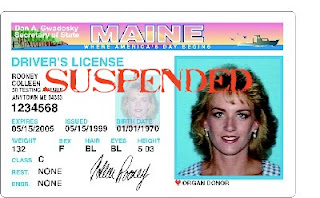
suspended maine driver's license
I love her hair in this picture

The Bad News: Penalties for those convicted of operating after suspension or revocation can be harsh!


Maine has some pretty bad law on driving after suspension or revocation. Fist off, it's easy to get your driver's license suspended in Maine. Not paying a fine, conviction for other driving offenses, accumulating points, or just changing your car insurance coverage can all result in suspension. Even after you fix the problem that got you suspended, your license will not be restored until you pay a "reinstatement fee" of $50 to the Bureau of Motor Vehicles. That's $50 for every suspension, so people with a late fine, lapsed insurance and a speeding ticket or two can be into hundreds of dollars pretty quick. That fee can leave a 15 day suspension in effect for years. To make matters worse, a suspension notice letter should be sent, but State mail does not get forwarded. If you moved, and have not update the address on your license, you won't get the notice and you might not know about any of this until you get pulled over.

The penalties seem pretty minor at first: A first OAS has a mandatory $250 fine, a second offense is $500 and a third is $750. The problem is that, if you plead guilty, the court will send the Bureau of Motor Vehicles notice of the conviction and BMV will suspend your license again for 60 days, maybe more if you have prior suspensions. Once you have three convictions for operating after suspension, or certain other offenses within a 5 year period, you can become classified as a Habitual Offender (HO) and your license will be revoked for three years.

If you drive after revocation, you are subject to mandatory minimum penalties which include incarceration for 30 days to two years depending on your priors. An HO driver who is intoxicated, eludes police, passes a road block or exceeds the speedlimit by 30 mph or more can be charged with "Aggravated operating after habitual offender revocation" and the minimum incarceration ranges from 6 months to 5 years!

The Good News: A lawyer can defend these cases.


There are ways to fight these cases. If a traffic stop led to charges, the prosecution must prove that the traffic stop was legal. Pulling someone over on a hunch that they are suspended, or because the car looked suspicious, probably is not enough. An illegal traffic stop could lead to the exclusion of all evidence discovered as a result of the stop.

The state also must prove that the defendant operated the vehicle, and under many circumstances, operation can be an issue. Often, police will find a parked car and form the opinion that a suspended suspect drive to that location. I have seen a few cases recently where an officer saw someone driving around town. The officer claims to recognize the car or driver and believes that the person is suspended. The officer then arrives at the person's home a day or two later to summons them for OAS. The question in any of these cases becomes whether the State can prove that the suspended person operated the car on the prior day.

Even if the stop was good and operation is clear, the question is was the driver properly suspended? The fact that the license is suspended or revoked is not enough to prove the case. The law requiers that one be properly notified of their habitual offender, or suspension status; it does not require proof that you actually received the notice as long as it is sent to the correct place. Notices often go to the wrong address. BMV may have multiple addresses on file and send the letter to just one, the court may send fine payment suspension notices to whatever address they happen to have in the file without ever checking the BMV address, police report addresses for the driver may differ from the court and BMV address and might be disregarded by both agencies. Other issues arise where prior convictions are alleged. The law only counts certain convictions as priors and those can only count against if the process that lead to conviction conformed with your rights to counsel and to a jury trial.

Figuring these issues out requiers meeting with a lawyer who knows the laws, knows the defenses, can make sense of your driving history report, and can fully investigate all information that might have an impact on the case. Don't think that an OAS of HO charge is always an open and shut case. A large percentage of cases can be defended in some way. Pleading guilty is  great way to guarantee a conviction and another round of suspension or revocation.